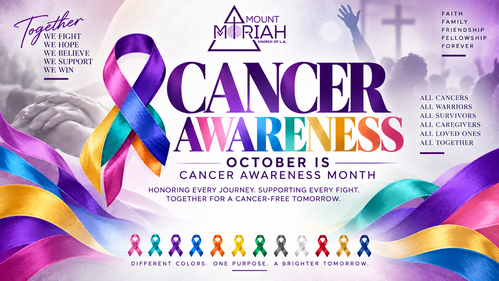
CANCER AWARENESS: MENTAL HEALTH
When any person hears the diagnosis of cancer the emotional and psychological impact may be varied. A typical initial reaction may be one of denial evidenced by shock and disbelief: “This can’t be happening to me”. Don’t allow denial to keep you from taking action—follow up with your medical provider!
Following denial you may experience additional emotions and symptoms such as:
symptoms are mild, ask your oncology team if you can exercise. Walking is exercise that can activate hormones such as endorphins, which may improve your mental health.
Reach out to family, church family and friends for support. Reach out to the Counseling Ministry at Mount Moriah. The power of Christian faith and belief including church
fellowship often results in improved health outcomes. Consider local support groups, specific to different types of cancer are available in the area. The American Cancer
Society and other organizations list support groups on their websites.
However, if the symptoms of depression or anxiety last continuously for two weeks or more or worsen it may be time to seek treatment with a mental health provider. You can
ask your oncology team or your medical insurance membership service department for a referral to a mental health provider.
IMPORTANT: If you frequently think about death, suicide, or self-harm but do not intend
to act on those thoughts, call 988, a 24-hour suicide hotline staffed by licensed therapists who are ready to talk with you. If you begin developing a suicide plan, attempt suicide, or engage in any self-destructive behavior, call 911 or go to the nearest emergency room immediately.
As Christians we have a unique relationship with God, our Father. We know we are saved by His grace. We have the assurance of our place in Heaven. This assurance
can be a powerful source of strength, peace and support during treatment. As Christians we can trust God through His powerful word. Find a favorite scripture to memorize and focus on during your treatment and survivorship. Psalm 138:8 “God will accomplish that which concerns you. Do not forsake the work of thy hands”. God won’t forget about you (Me—personalize your scripture!). God asks us to pray without
ceasing I Thes 5:17. We can ask God to give us wisdom to find the right medical/oncology team—Proverbs 4.
We can ask God for mustard seed faith to trust Him for healing—Luke 17:5, 6.
We can ask God to keep our minds on Him; to maintain positive thoughts to promote
healing and support others through cancer treatment and survival! Philippians 4:8.
Following denial you may experience additional emotions and symptoms such as:
- Anxiety: symptoms of worry, fear of the unknown, fleeting thoughts of dying, muscle tension, changes in appetite and sleep, mood: irritable, or sad. You may experience panic attacks: shortness of breath, heart palpitations, chest pain/pressure, nervous, stomach upset, shaking, perspiring, headaches.
- Depression: symptoms of sadness, fatigue, loss of interest in things you normally enjoy, forgetful, crying, feeling punished, angry feelings with thoughts that ‘my body betrayed me’, sleep and appetite changes, agitation, decreased concentration, decreased motivation, feeling hopeless and/or helpless, avoiding friends and family.
symptoms are mild, ask your oncology team if you can exercise. Walking is exercise that can activate hormones such as endorphins, which may improve your mental health.
Reach out to family, church family and friends for support. Reach out to the Counseling Ministry at Mount Moriah. The power of Christian faith and belief including church
fellowship often results in improved health outcomes. Consider local support groups, specific to different types of cancer are available in the area. The American Cancer
Society and other organizations list support groups on their websites.
However, if the symptoms of depression or anxiety last continuously for two weeks or more or worsen it may be time to seek treatment with a mental health provider. You can
ask your oncology team or your medical insurance membership service department for a referral to a mental health provider.
IMPORTANT: If you frequently think about death, suicide, or self-harm but do not intend
to act on those thoughts, call 988, a 24-hour suicide hotline staffed by licensed therapists who are ready to talk with you. If you begin developing a suicide plan, attempt suicide, or engage in any self-destructive behavior, call 911 or go to the nearest emergency room immediately.
As Christians we have a unique relationship with God, our Father. We know we are saved by His grace. We have the assurance of our place in Heaven. This assurance
can be a powerful source of strength, peace and support during treatment. As Christians we can trust God through His powerful word. Find a favorite scripture to memorize and focus on during your treatment and survivorship. Psalm 138:8 “God will accomplish that which concerns you. Do not forsake the work of thy hands”. God won’t forget about you (Me—personalize your scripture!). God asks us to pray without
ceasing I Thes 5:17. We can ask God to give us wisdom to find the right medical/oncology team—Proverbs 4.
We can ask God for mustard seed faith to trust Him for healing—Luke 17:5, 6.
We can ask God to keep our minds on Him; to maintain positive thoughts to promote
healing and support others through cancer treatment and survival! Philippians 4:8.
CANCER AWARENESS: SKIN CANCER
Skin cancer is by far the most common type of cancer. If you have skin cancer, it is important to know which type you have because it affects your treatment options and your outlook (prognosis). If you aren’t sure which type of skin cancer you have, ask your doctor so you can get the right information.
Basal cell carcinoma
Basal cell carcinoma (BCC), also called basal cell skin cancer or basal cell cancer, is the most common type of skin cancer. About 8 out of 10 skin cancers are basal cell carcinomas.
BCCs start in the basal cell layer of the skin, usually on sun-exposed areas, especially the face, head, neck, and arms.
These cancers tend to grow slowly. But they are left untreated, it can grow into nearby areas and invade the bones or other tissues beneath the skin. It’s rare for BCC to spread to other parts of the body.
If not removed completely, BCC can come back (recur) in the same place on the skin. People who have had basal cell skin cancers are also more likely to get new ones in other areas of the skin.
What causes basal cell carcinoma?
There are many known risk factors for basal cell skin cancer, but it’s not always clear exactly how these factors might cause cancer.
The main cause of basal cell skin cancer is repeated and unprotected skin exposure to ultraviolet (UV) rays from sunlight, tanning beds, or sun lamps. UV rays can cause changes in the DNA (genes) inside skin cells.
Can basal cell carcinoma be prevented?
Look for shade
Simply staying in the shade is one of the best ways to limit your UV exposure.
Use sun protection
If you are going to be in the sun:
Discuss treatment options with your cancer care team. These options may include surgery, or non-surgical treatment, radiation, chemotherapy and/or immunotherapy for advanced skin cancer.
Resource: American Cancer Society
Basal cell carcinoma
Basal cell carcinoma (BCC), also called basal cell skin cancer or basal cell cancer, is the most common type of skin cancer. About 8 out of 10 skin cancers are basal cell carcinomas.
BCCs start in the basal cell layer of the skin, usually on sun-exposed areas, especially the face, head, neck, and arms.
These cancers tend to grow slowly. But they are left untreated, it can grow into nearby areas and invade the bones or other tissues beneath the skin. It’s rare for BCC to spread to other parts of the body.
If not removed completely, BCC can come back (recur) in the same place on the skin. People who have had basal cell skin cancers are also more likely to get new ones in other areas of the skin.
What causes basal cell carcinoma?
There are many known risk factors for basal cell skin cancer, but it’s not always clear exactly how these factors might cause cancer.
The main cause of basal cell skin cancer is repeated and unprotected skin exposure to ultraviolet (UV) rays from sunlight, tanning beds, or sun lamps. UV rays can cause changes in the DNA (genes) inside skin cells.
Can basal cell carcinoma be prevented?
Look for shade
Simply staying in the shade is one of the best ways to limit your UV exposure.
Use sun protection
If you are going to be in the sun:
- Wear a shirt and a wide-brimmed hat.
- Apply sunscreen to areas not covered by clothing.
- Put on sunglasses to protect your eyes and sensitive skin around them.
- With self-exams and skin checks by a healthcare professional, basal cell skin cancers can often be found early, when treatment is more likely to be successful.
- Although the American Cancer Society does not have guidelines for the early detection of skin cancer, many doctors recommend checking your own skin regularly, preferably once a month.
- Knowing your own skin is important to finding skin cancer early. Learn the patterns of moles, blemishes, freckles, and other marks on your skin so that you’ll notice any changes.
- Skin self-exams are best done in a well-lit room in front of a full-length mirror. Use a handheld mirror for areas that are hard to see, such as the backs of your thighs.
- Examine all parts of your body, including the palms of your hands and soles of your feet, as well as your nails, scalp, ears, and back. A spouse, partner, close friend, or family member can also help you with these exams, especially for hard-to-see areas, such as your scalp and back.
Discuss treatment options with your cancer care team. These options may include surgery, or non-surgical treatment, radiation, chemotherapy and/or immunotherapy for advanced skin cancer.
Resource: American Cancer Society
CANCER AWARENESS BRAIN CANCER
Brain Tumors in Adults
Are brain tumors always cancer
Brain tumors and spinal cord tumors can be benign (non-cancerous) or malignant (cancer):
Can brain tumors be found early?
At this time, there are no widely recommended tests to screen for brain tumors. (Screening is testing for a disease in people who have no symptoms.) Instead, most brain tumors are found because they start to cause symptoms, such as:
Resource: American Cancer Society
Are brain tumors always cancer
Brain tumors and spinal cord tumors can be benign (non-cancerous) or malignant (cancer):
- Benign tumors can grow bigger and press on nearby areas. But they don’t grow directly into nearby tissues or spread to other parts of the body, so benign tumors in most parts of the body are almost never life-threatening.
- Malignant tumors (cancers) can grow into (invade) nearby structures and might even spread to other parts of the body.
Can brain tumors be found early?
At this time, there are no widely recommended tests to screen for brain tumors. (Screening is testing for a disease in people who have no symptoms.) Instead, most brain tumors are found because they start to cause symptoms, such as:
- Headache
- Seizures
- Nausea
- Vomiting
- Blurred vision
- Balance problems
- Personality or behavior changes
- Drowsiness or even coma
Resource: American Cancer Society
CANCER AWARENESS BREAST CANCER
What causes breast cancer?
Certain gene changes (mutations) in normal cells can affect the way the genes work. When this happens, it can cause abnormal cells to grow and lead to cancer.
We don’t know what exactly causes each case of breast cancer. But there are some known risk factors for these cancers.
A risk factor is anything that affects a person’s chance of getting a disease. For example, hormones and factors such as weight, diet, and exercise seem to play a role in many cases of breast cancer.
While some of the factors that may cause gene changes are known, it’s not clear exactly how they lead to breast cancer. In some cases, these gene changes can be passed on in families. Researchers are studying this to learn more.
Can breast cancer be found early?
Breast cancer screening can find breast cancer before symptoms appear and when treatment is more likely to be successful. This is why regular age-appropriate breast cancer screening is so important.
Signs and symptoms of breast cancer
The most common symptom of breast cancer is a new lump or mass in the breast, but other symptoms, such as skin changes or nipple discharge, are also possible. It's important to know your body and have any changes checked out by a healthcare provider
Biopsy
A biopsy is a procedure that removes a small piece of tissue so it can be examined. It is done when a test or physical exam of the breast shows a change that might be cancer. A biopsy is the only way to know for sure whether an abnormal area is cancer.
How is breast cancer treated?
Most people with early-stage breast cancer will have some type of surgery to remove the tumor.
You might also need other types of treatment. This will depend on your type of breast cancer and how advanced it is. These other treatments, for example, radiation or chemotherapy might happen before surgery, after surgery, or both.
Resource: American Cancer Society
Certain gene changes (mutations) in normal cells can affect the way the genes work. When this happens, it can cause abnormal cells to grow and lead to cancer.
We don’t know what exactly causes each case of breast cancer. But there are some known risk factors for these cancers.
A risk factor is anything that affects a person’s chance of getting a disease. For example, hormones and factors such as weight, diet, and exercise seem to play a role in many cases of breast cancer.
While some of the factors that may cause gene changes are known, it’s not clear exactly how they lead to breast cancer. In some cases, these gene changes can be passed on in families. Researchers are studying this to learn more.
Can breast cancer be found early?
Breast cancer screening can find breast cancer before symptoms appear and when treatment is more likely to be successful. This is why regular age-appropriate breast cancer screening is so important.
Signs and symptoms of breast cancer
The most common symptom of breast cancer is a new lump or mass in the breast, but other symptoms, such as skin changes or nipple discharge, are also possible. It's important to know your body and have any changes checked out by a healthcare provider
Biopsy
A biopsy is a procedure that removes a small piece of tissue so it can be examined. It is done when a test or physical exam of the breast shows a change that might be cancer. A biopsy is the only way to know for sure whether an abnormal area is cancer.
How is breast cancer treated?
Most people with early-stage breast cancer will have some type of surgery to remove the tumor.
You might also need other types of treatment. This will depend on your type of breast cancer and how advanced it is. These other treatments, for example, radiation or chemotherapy might happen before surgery, after surgery, or both.
Resource: American Cancer Society
CANCER AWARENESS PROSTATE CANCER
What Is Prostate Cancer?
Prostate cancer begins when cells in the prostate gland start to grow out of control. The prostate is a gland found only in males. It makes some of the fluid that is part of semen.
The prostate
The prostate is below the bladder (the hollow organ where urine is stored) and in front of the rectum (the last part of the intestines). Just behind the prostate are glands called seminal vesicles, which make most of the fluid for semen. The urethra, which is the tube that carries urine and semen out of the body through the penis, goes through the center of the prostate.
Types of prostate cancer
Almost all prostate cancers are adenocarcinomas. These cancers develop from the gland cells in the prostate (the cells that make the prostate fluid that is added to the semen).
Risk factors
Older age
Prostate cancer is rare in men younger than 40, but the chance of having prostate cancer rises rapidly after age 50. About 6 in 10 prostate cancers are found in men older than 65.
Race/ethnicity
Prostate cancer develops more often in African American men and in Caribbean men of African ancestry than in men of other races. And when it does develop in these men, they tend to be younger.
Prostate cancer occurs less often in Asian American, Hispanic, and Latino men than in non-Hispanic White men. The reasons for these racial and ethnic differences are not clear.
Family history
Prostate cancer seems to run in some families, which suggests that in some cases there may be an inherited or genetic factor. Still, most prostate cancers occur in men without a family history of it.
Having a father or brother with prostate cancer more than doubles a man’s risk of developing this disease. (The risk is higher for men who have a brother with the disease than for those who have a father with it.) The risk is much higher for men with several affected relatives, particularly if their relatives were young when the cancer was found.
Screening options for prostate cancer
Prostate cancer can often be found early by testing for prostate-specific antigen (PSA) levels in a man’s blood. A digital rectal exam (DRE) is an option along with a PSA test, although it is not as good at finding prostate cancer. For a DRE, the doctor puts a gloved, lubricated finger into the rectum to feel the prostate gland. These tests and the actual process of screening are described in more detail in Screening Tests for Prostate Cancer.
If the results of either of these tests are abnormal, further testing (such as a prostate biopsy) is often done to see if a man has cancer.
Finding prostate cancer early
The main benefit of screening is that if prostate cancer is found, it’s likely to be at an earlier stage than if no screening were done. This will most likely mean that the cancer is easier to treat.
Who treats prostate cancer?
The main types of doctors who treat prostate cancer include:
How is prostate cancer treated?
Various options are available, consult your cancer care team for the best plan for you.
Prostate cancer begins when cells in the prostate gland start to grow out of control. The prostate is a gland found only in males. It makes some of the fluid that is part of semen.
The prostate
The prostate is below the bladder (the hollow organ where urine is stored) and in front of the rectum (the last part of the intestines). Just behind the prostate are glands called seminal vesicles, which make most of the fluid for semen. The urethra, which is the tube that carries urine and semen out of the body through the penis, goes through the center of the prostate.
Types of prostate cancer
Almost all prostate cancers are adenocarcinomas. These cancers develop from the gland cells in the prostate (the cells that make the prostate fluid that is added to the semen).
Risk factors
Older age
Prostate cancer is rare in men younger than 40, but the chance of having prostate cancer rises rapidly after age 50. About 6 in 10 prostate cancers are found in men older than 65.
Race/ethnicity
Prostate cancer develops more often in African American men and in Caribbean men of African ancestry than in men of other races. And when it does develop in these men, they tend to be younger.
Prostate cancer occurs less often in Asian American, Hispanic, and Latino men than in non-Hispanic White men. The reasons for these racial and ethnic differences are not clear.
Family history
Prostate cancer seems to run in some families, which suggests that in some cases there may be an inherited or genetic factor. Still, most prostate cancers occur in men without a family history of it.
Having a father or brother with prostate cancer more than doubles a man’s risk of developing this disease. (The risk is higher for men who have a brother with the disease than for those who have a father with it.) The risk is much higher for men with several affected relatives, particularly if their relatives were young when the cancer was found.
Screening options for prostate cancer
Prostate cancer can often be found early by testing for prostate-specific antigen (PSA) levels in a man’s blood. A digital rectal exam (DRE) is an option along with a PSA test, although it is not as good at finding prostate cancer. For a DRE, the doctor puts a gloved, lubricated finger into the rectum to feel the prostate gland. These tests and the actual process of screening are described in more detail in Screening Tests for Prostate Cancer.
If the results of either of these tests are abnormal, further testing (such as a prostate biopsy) is often done to see if a man has cancer.
Finding prostate cancer early
The main benefit of screening is that if prostate cancer is found, it’s likely to be at an earlier stage than if no screening were done. This will most likely mean that the cancer is easier to treat.
Who treats prostate cancer?
The main types of doctors who treat prostate cancer include:
- Urologist: A surgeon who treats diseases of the urinary system and male reproductive system, including the prostate
- Radiation oncologist: A doctor who treats cancer with radiation therapy
- Medical oncologist: A doctor who treats cancer with medicines, such as chemotherapy, hormone therapy, targeted therapy, and immunotherapy
How is prostate cancer treated?
Various options are available, consult your cancer care team for the best plan for you.
- Observation and surveillance (which may include more frequent tests)
- Surgery
- Radiation
- Chemotherapy or other therapy options
- Immunotherapy
- Targeted therapy
CANCER AWARENESS LUNG CANCER
Types of lung cancer
The main types of lung cancer are: non-small cell lung cancer (NSCLC) and small cell lung cancer (SCLC).
Non-small cell lung cancer (NSCLC)
About 80% to 85% of lung cancers are NSCLC. The main subtypes of NSCLC are adenocarcinoma, squamous cell carcinoma, and large cell carcinoma. These subtypes, which start from different types of lung cells, are grouped together as NSCLC because their treatment and prognoses (outlooks) are often similar.
Small cell lung cancer (SCLC)
About 10% to 15% of all lung cancers are SCLC.
This type of lung cancer tends to grow and spread faster than NSCLC. In most people with SCLC, the cancer has already spread beyond the lungs at the time it is diagnosed. Since this cancer grows quickly, it tends to respond well to chemotherapy and radiation therapy. Unfortunately, for most people the cancer will return at some point.
Factors that may affect lung cancer risk
Smoking is by far the leading risk factor for lung cancer. About 80% of lung cancer deaths are thought to result from smoking, and this number is probably even higher for small cell lung cancer (SCLC). It’s rare for someone who has never smoked to have SCLC.
The risk of lung cancer for people who smoke is many times higher than for people who don’t smoke. The longer you smoke and the more packs a day you smoke, the greater your risk.
Cigar smoking, pipe smoking, and menthol cigarette smoking are almost as likely to cause lung cancer as cigarette smoking. Smoking low-tar or “light” cigarettes increases lung cancer risk as much as regular cigarettes.
Secondhand smoke
If you don’t smoke, breathing in the smoke of others (called secondhand smoke or environmental tobacco smoke) can increase your risk of developing lung cancer. Secondhand smoke is the third most common cause of lung cancer in the United States.
If you or someone you care about needs help quitting, see How to Quit Using Tobacco or call the American Cancer Society at 1-800-227-2345.
Risk factors you cannot change:
Previous radiation therapy to the lungs
People who have had radiation therapy to the chest for other cancers are at higher risk for lung cancer, particularly if they smoke. Examples include people who have been treated for Hodgkin lymphoma or women who were treated with chest radiation for breast cancer.
Air pollution
In cities, air pollution, such as from diesel exhaust, appears to raise the risk of lung cancer slightly. This risk is far less than the risk caused by smoking, but about 1% to 2% of all deaths from lung cancer in the United States are thought to be due to outdoor air pollution.
Personal or family history of lung cancer
If you have had lung cancer, you have a higher risk of developing another lung cancer.
Brothers, sisters, and children of people who have had lung cancer may have a slightly higher risk of lung cancer themselves, especially if the relative was diagnosed at a younger age. It’s not clear how much of this risk might be due to shared genes among family members and how much might be from shared household exposures (such as tobacco smoke or radon).
The most common lung cancer symptoms
The most common symptoms of lung cancer are:
There are various treatment options dependent upon the type of lung cancer, staging, and your overall health. Discuss your treatment options with your cancer care team.
The main types of lung cancer are: non-small cell lung cancer (NSCLC) and small cell lung cancer (SCLC).
Non-small cell lung cancer (NSCLC)
About 80% to 85% of lung cancers are NSCLC. The main subtypes of NSCLC are adenocarcinoma, squamous cell carcinoma, and large cell carcinoma. These subtypes, which start from different types of lung cells, are grouped together as NSCLC because their treatment and prognoses (outlooks) are often similar.
Small cell lung cancer (SCLC)
About 10% to 15% of all lung cancers are SCLC.
This type of lung cancer tends to grow and spread faster than NSCLC. In most people with SCLC, the cancer has already spread beyond the lungs at the time it is diagnosed. Since this cancer grows quickly, it tends to respond well to chemotherapy and radiation therapy. Unfortunately, for most people the cancer will return at some point.
Factors that may affect lung cancer risk
Smoking is by far the leading risk factor for lung cancer. About 80% of lung cancer deaths are thought to result from smoking, and this number is probably even higher for small cell lung cancer (SCLC). It’s rare for someone who has never smoked to have SCLC.
The risk of lung cancer for people who smoke is many times higher than for people who don’t smoke. The longer you smoke and the more packs a day you smoke, the greater your risk.
Cigar smoking, pipe smoking, and menthol cigarette smoking are almost as likely to cause lung cancer as cigarette smoking. Smoking low-tar or “light” cigarettes increases lung cancer risk as much as regular cigarettes.
Secondhand smoke
If you don’t smoke, breathing in the smoke of others (called secondhand smoke or environmental tobacco smoke) can increase your risk of developing lung cancer. Secondhand smoke is the third most common cause of lung cancer in the United States.
If you or someone you care about needs help quitting, see How to Quit Using Tobacco or call the American Cancer Society at 1-800-227-2345.
Risk factors you cannot change:
Previous radiation therapy to the lungs
People who have had radiation therapy to the chest for other cancers are at higher risk for lung cancer, particularly if they smoke. Examples include people who have been treated for Hodgkin lymphoma or women who were treated with chest radiation for breast cancer.
Air pollution
In cities, air pollution, such as from diesel exhaust, appears to raise the risk of lung cancer slightly. This risk is far less than the risk caused by smoking, but about 1% to 2% of all deaths from lung cancer in the United States are thought to be due to outdoor air pollution.
Personal or family history of lung cancer
If you have had lung cancer, you have a higher risk of developing another lung cancer.
Brothers, sisters, and children of people who have had lung cancer may have a slightly higher risk of lung cancer themselves, especially if the relative was diagnosed at a younger age. It’s not clear how much of this risk might be due to shared genes among family members and how much might be from shared household exposures (such as tobacco smoke or radon).
The most common lung cancer symptoms
The most common symptoms of lung cancer are:
- A cough that does not go away or gets worse
- Coughing up blood or rust-colored sputum (spit or phlegm)
- Chest pain that is often worse with deep breathing, coughing, or laughing
- Hoarseness
- Loss of appetite
- Unexplained weight loss
- Shortness of breath
- Feeling tired or weak
- Infections such as bronchitis and pneumonia that don’t go away or keep coming back
- New onset of wheezing
There are various treatment options dependent upon the type of lung cancer, staging, and your overall health. Discuss your treatment options with your cancer care team.
- Surgery
- Radiation
- Chemotherapy
- Immunotherapy
CANCER AWARENESS COLORECTAL CANCER
What Is Colorectal Cancer?
Colorectal cancer starts in the colon or the rectum. These cancers can also be called colon cancer or rectal cancer, depending on where they start. Colon cancer and rectal cancer are often grouped together because they have many features in common.
Polyps in the colon or rectum
Most colorectal cancers start as a growth on the inner lining of the colon or rectum. These growths are called polyps.
Polyps are quite common, especially as you get older. Most polyps are benign, or noncancerous. Some types of polyps can change into cancer over time (usually over many years). The chance of a polyp turning into cancer depends on the type of polyp it is. There are different types of polyps.
Risk factors you can change
Many lifestyle-related factors have been linked to colorectal cancer. In fact, more than half of all colorectal cancers are linked to risk factors that can be changed.
Excess body weight
If you have excess body weight (overweight or obesity), your risk of developing and dying from colorectal cancer is higher. Excess weight raises the risk of colorectal cancer in people, but the link seems to be stronger in men. Getting to and staying at a healthy weight may help lower your risk.
Diabetes mellitus, Type 2
People with type 2 diabetes mellitus are more likely than people who don’t to develop colorectal cancer. Researchers suspect that this higher risk may be due to high levels of insulin in people with diabetes mellitus. Both type 2 diabetes and colorectal cancer share some of the same risk factors (such as excess body weight and physical inactivity). But even after taking these factors into account, people with type 2 diabetes still have an increased risk. They also tend to have a less favorable prognosis (outlook) after diagnosis.
Certain types of diets
A long-term diet that's high in red meats (such as beef, pork, lamb, or liver) and processed meats (like hot dogs and some lunch meats) raises your colorectal cancer risk.
Cooking meats at very high temperatures (frying, broiling, or grilling) creates chemicals that might raise your cancer risk.
Having a low blood level of vitamin D may also increase your risk.
Following a healthy eating pattern that includes plenty of fruits, vegetables, and whole grains, and that limits or avoids red and processed meats and sugary drinks probably lowers risk.
Smoking
People who have smoked tobacco for a long time are more likely to develop and die from colorectal cancer than people who don't smoke. Smoking tobacco also increases the risk for people to develop colon polyps. Smoking is a well-known cause of lung cancer, but it's linked to a lot of other cancers, too. If you smoke and want to know more about quitting, see How to Quit Using Tobacco.
Alcohol use
Colorectal cancer has been linked to moderate to heavy alcohol use. Even light-to-moderate alcohol intake has been associated with some risk. It is best not to drink alcohol. If people do drink alcohol, they should have no more than 2 drinks a day for men and 1 drink a day for women. This could have many health benefits, including a lower risk of many kinds of cancer.
Colorectal cancer risk factors you cannot change
Your age
Your risk of colorectal cancer goes up as you age. Younger adults can get it, but it’s much more common after age 50. Colorectal cancer is rising among people who are younger than age 50, and the reason for this remains unclear.
Your racial and ethnic background
American Indian and Alaska Native people have the highest rates of colorectal cancer in the United States, followed by African American men and women.
Jews of Eastern European descent (Ashkenazi Jews) have one of the highest colorectal cancer risks of any ethnic group in the world.
Your sex at birth
Men who have colorectal cancer are more likely to die from it than women. The reasons are not fully clear. Women who have colorectal cancer are more likely to have right-sided colon cancer, particularly if they are no longer menstruating (postmenopausal).
Cholecystectomy
People who have had their gallbladder removed (cholecystectomy) have been found to have a mildly higher risk for right-sided colon cancer. It’s not fully understood why this is. Research is ongoing.
A personal history of colorectal polyps or colorectal cancer
If you have a history of adenomatous polyps (adenomas), you are at increased risk of developing colorectal cancer. This is especially true if the polyps are large, if there are many of them, or if any of them show dysplasia.
If you’ve had colorectal cancer, even though it was completely removed, you are more likely to develop new cancers in other parts of the colon and rectum. The chances of this happening are greater if you had your first colorectal cancer when you were younger.
A personal history of inflammatory bowel disease
If you have inflammatory bowel disease (IBD), including either ulcerative colitis or Crohn’s disease, your risk of colorectal cancer is increased.
IBD is a condition in which the colon is inflamed over a long period of time. People who have had IBD for many years, especially if untreated, often develop dysplasia. Dysplasia is a term used to describe cells in the lining of the colon or rectum that look abnormal, but are not cancer cells. They can change into cancer over time.
If you have IBD, you may need to start getting screened for colorectal cancer when you are younger and be screened more often.
Inflammatory bowel disease is different from irritable bowel syndrome (IBS), which does not appear to increase your risk for colorectal cancer.
A family history of colorectal cancer or adenomatous polyps
Most colorectal cancers are found in people without a family history of colorectal cancer. Still, as many as 1 in 3 people who develop colorectal cancer have other family members who have had it.
People with a history of colorectal cancer in a first-degree relative (parent, sibling, or child) are at increased risk. The risk is even higher if that relative was diagnosed with cancer when they were younger than age 50, or if more than one first-degree relative is affected.
Screening for colorectal cancer
Colorectal cancer is a leading cause of cancer death in the United States. But the death rate (the number of deaths per 100,000 people per year) for colorectal cancer has been dropping for several decades.
Regular colorectal cancer screening is one of the most powerful tools against colorectal cancer.
Who should get screened?
The American Cancer Society recommends that people at average risk of colorectal cancer start regular screening at age 45. People at higher risk might need to start earlier.
Unfortunately, about 1 in 3 people in the United States who should get tested for colorectal cancer have never been screened. This may be because they don’t know that regular testing could save their lives from this disease, or due to things like cost and health insurance coverage issues.
Treating Colorectal Cancer
Consult with your cancer care team and family regarding treatment options that are best for you.
Colorectal cancer starts in the colon or the rectum. These cancers can also be called colon cancer or rectal cancer, depending on where they start. Colon cancer and rectal cancer are often grouped together because they have many features in common.
Polyps in the colon or rectum
Most colorectal cancers start as a growth on the inner lining of the colon or rectum. These growths are called polyps.
Polyps are quite common, especially as you get older. Most polyps are benign, or noncancerous. Some types of polyps can change into cancer over time (usually over many years). The chance of a polyp turning into cancer depends on the type of polyp it is. There are different types of polyps.
Risk factors you can change
Many lifestyle-related factors have been linked to colorectal cancer. In fact, more than half of all colorectal cancers are linked to risk factors that can be changed.
Excess body weight
If you have excess body weight (overweight or obesity), your risk of developing and dying from colorectal cancer is higher. Excess weight raises the risk of colorectal cancer in people, but the link seems to be stronger in men. Getting to and staying at a healthy weight may help lower your risk.
Diabetes mellitus, Type 2
People with type 2 diabetes mellitus are more likely than people who don’t to develop colorectal cancer. Researchers suspect that this higher risk may be due to high levels of insulin in people with diabetes mellitus. Both type 2 diabetes and colorectal cancer share some of the same risk factors (such as excess body weight and physical inactivity). But even after taking these factors into account, people with type 2 diabetes still have an increased risk. They also tend to have a less favorable prognosis (outlook) after diagnosis.
Certain types of diets
A long-term diet that's high in red meats (such as beef, pork, lamb, or liver) and processed meats (like hot dogs and some lunch meats) raises your colorectal cancer risk.
Cooking meats at very high temperatures (frying, broiling, or grilling) creates chemicals that might raise your cancer risk.
Having a low blood level of vitamin D may also increase your risk.
Following a healthy eating pattern that includes plenty of fruits, vegetables, and whole grains, and that limits or avoids red and processed meats and sugary drinks probably lowers risk.
Smoking
People who have smoked tobacco for a long time are more likely to develop and die from colorectal cancer than people who don't smoke. Smoking tobacco also increases the risk for people to develop colon polyps. Smoking is a well-known cause of lung cancer, but it's linked to a lot of other cancers, too. If you smoke and want to know more about quitting, see How to Quit Using Tobacco.
Alcohol use
Colorectal cancer has been linked to moderate to heavy alcohol use. Even light-to-moderate alcohol intake has been associated with some risk. It is best not to drink alcohol. If people do drink alcohol, they should have no more than 2 drinks a day for men and 1 drink a day for women. This could have many health benefits, including a lower risk of many kinds of cancer.
Colorectal cancer risk factors you cannot change
Your age
Your risk of colorectal cancer goes up as you age. Younger adults can get it, but it’s much more common after age 50. Colorectal cancer is rising among people who are younger than age 50, and the reason for this remains unclear.
Your racial and ethnic background
American Indian and Alaska Native people have the highest rates of colorectal cancer in the United States, followed by African American men and women.
Jews of Eastern European descent (Ashkenazi Jews) have one of the highest colorectal cancer risks of any ethnic group in the world.
Your sex at birth
Men who have colorectal cancer are more likely to die from it than women. The reasons are not fully clear. Women who have colorectal cancer are more likely to have right-sided colon cancer, particularly if they are no longer menstruating (postmenopausal).
Cholecystectomy
People who have had their gallbladder removed (cholecystectomy) have been found to have a mildly higher risk for right-sided colon cancer. It’s not fully understood why this is. Research is ongoing.
A personal history of colorectal polyps or colorectal cancer
If you have a history of adenomatous polyps (adenomas), you are at increased risk of developing colorectal cancer. This is especially true if the polyps are large, if there are many of them, or if any of them show dysplasia.
If you’ve had colorectal cancer, even though it was completely removed, you are more likely to develop new cancers in other parts of the colon and rectum. The chances of this happening are greater if you had your first colorectal cancer when you were younger.
A personal history of inflammatory bowel disease
If you have inflammatory bowel disease (IBD), including either ulcerative colitis or Crohn’s disease, your risk of colorectal cancer is increased.
IBD is a condition in which the colon is inflamed over a long period of time. People who have had IBD for many years, especially if untreated, often develop dysplasia. Dysplasia is a term used to describe cells in the lining of the colon or rectum that look abnormal, but are not cancer cells. They can change into cancer over time.
If you have IBD, you may need to start getting screened for colorectal cancer when you are younger and be screened more often.
Inflammatory bowel disease is different from irritable bowel syndrome (IBS), which does not appear to increase your risk for colorectal cancer.
A family history of colorectal cancer or adenomatous polyps
Most colorectal cancers are found in people without a family history of colorectal cancer. Still, as many as 1 in 3 people who develop colorectal cancer have other family members who have had it.
People with a history of colorectal cancer in a first-degree relative (parent, sibling, or child) are at increased risk. The risk is even higher if that relative was diagnosed with cancer when they were younger than age 50, or if more than one first-degree relative is affected.
Screening for colorectal cancer
Colorectal cancer is a leading cause of cancer death in the United States. But the death rate (the number of deaths per 100,000 people per year) for colorectal cancer has been dropping for several decades.
Regular colorectal cancer screening is one of the most powerful tools against colorectal cancer.
Who should get screened?
The American Cancer Society recommends that people at average risk of colorectal cancer start regular screening at age 45. People at higher risk might need to start earlier.
Unfortunately, about 1 in 3 people in the United States who should get tested for colorectal cancer have never been screened. This may be because they don’t know that regular testing could save their lives from this disease, or due to things like cost and health insurance coverage issues.
Treating Colorectal Cancer
Consult with your cancer care team and family regarding treatment options that are best for you.
- Surgery
- Ablation and embolization
- Radiation
- Chemotherapy
- Targeted therapy medication
- Immunotherapy